
New Jersey Homicide Defense Lawyer
A homicide investigation or murder charge in New Jersey can upend your life—and the decisions made in the earliest hours matter most. The Law Office of Michele Finizio defends individuals facing homicide charges across Burlington, Camden, and Gloucester counties, providing experienced, strategic representation from the moment an investigation begins through trial and sentencing.
A conviction for murder in New Jersey carries a mandatory minimum of 30 years in state prison. The consequences extend far beyond incarceration—they affect your family, your career, and every aspect of your future. If you or a loved one is under investigation for a death, has been arrested on murder or manslaughter charges, or has been contacted by law enforcement, early legal representation is not optional. It is essential.
Michele Finizio represents clients at every stage of the process, including before formal charges are ever filed.
Contact the Law Office of Michele Finizio for a free, no-obligation consultation.
Defense Representation for Homicide Charges in New Jersey
Homicide cases are among the most complex and high-stakes matters in the criminal justice system. Investigations often begin long before an arrest—law enforcement may be executing search warrants, collecting DNA samples, reviewing surveillance footage, pulling cell phone records, and interviewing witnesses while a suspect is still unaware they are a target.
This is why retaining a criminal homicide lawyer early is so critical. A defense attorney can:
- Protect your constitutional rights during police interviews and search warrant execution
- Ensure that potentially exculpatory evidence is preserved
- Monitor and respond to investigative activity before charges are filed
- Retain independent forensic and scientific experts
- Influence the prosecution’s theory of the case before an indictment is sought
Michele Finizio and Matt Spittal brings years of criminal defense experience and a thorough understanding of forensic evidence to homicide cases throughout South Jersey. She represents clients during all phases of the case:
- Pre-charge investigations
- Arrests and criminal complaints
- Detention hearings
- Grand jury proceedings
- Pretrial motions
- Plea negotiations
- Trial preparation and jury trials
- Sentencing proceedings
What Is Criminal Homicide Under New Jersey Law?
Criminal homicide under New Jersey law is defined as purposefully, knowingly, or recklessly causing the death of another person. The classification of the offense—and the severity of the penalties—depends on the defendant’s mental state and the circumstances surrounding the death.
Murder
Murder is the most serious criminal homicide charge and a first-degree indictable offense. To secure a murder conviction, prosecutors must prove that the defendant purposefully and knowingly killed another person, or caused serious bodily injury that resulted in death with extreme indifference to human life.
Real-world examples: A defendant who shoots a victim during a domestic dispute, or who inflicts fatal injuries during a gang-related confrontation, may face first-degree murder charges depending on the evidence of intent.
Aggravated Manslaughter
Aggravated manslaughter involves reckless conduct that reflects extreme indifference to human life—conduct that creates a high probability (not merely a possibility) that death will result. It is a first-degree offense and also applies when death occurs while a person is fleeing from a law enforcement officer.
Real-world example: Firing a weapon into a crowd where death is a probable outcome may support an aggravated manslaughter charge.
Reckless Manslaughter
Reckless manslaughter is a second-degree offense. It occurs when a person consciously disregards a substantial and unjustifiable risk, and that disregard constitutes a gross deviation from reasonable conduct—resulting in another person’s death.
Real-world example: Providing dangerous drugs such as heroin or fentanyl to another person who subsequently dies of an overdose can support a reckless manslaughter charge. Drug overdose investigations in New Jersey increasingly result in this charge being pursued against suppliers or co-users.
Felony Murder
Felony murder is one of the most misunderstood charges in New Jersey criminal law. Under the felony murder rule, a person can be charged with murder even if they did not intend to kill anyone—or even if someone else actually caused the death.
Felony murder applies when a death occurs during the commission of one of eight specific serious crimes under New Jersey law:
- Robbery
- Sexual assault
- Arson
- Burglary
- Kidnapping
- Carjacking
- Criminal escape
- Terrorism
Why felony murder is often misunderstood: Many people assume that murder charges require an intent to kill. Felony murder eliminates this requirement entirely. If you participated in a robbery and a co-defendant shot and killed the victim, you may face murder charges even though you never touched a weapon. Accomplice liability under the felony murder doctrine means that all participants in the underlying crime can be held responsible for the death—regardless of who caused it.
Real-world example: A defendant who serves as a lookout during a robbery in which a store owner is killed may be charged with felony murder, even with no intent to harm the victim and no physical involvement in the shooting.
Because of the complexity of accomplice liability in felony murder cases, early representation by a felony murder attorney is critical to building an effective defense strategy.
What Must Prosecutors Prove in a New Jersey Homicide Case?
To obtain a homicide conviction, prosecutors must prove every element of the charge beyond a reasonable doubt. The specific elements vary depending on the charge, but generally include:
- Death of another person — The prosecution must establish that a human being died.
- The defendant caused the death — There must be a causal connection between the defendant’s conduct and the death. This is known as causation.
- The required mental state — Depending on the charge, prosecutors must prove purposeful or knowing conduct (murder), extreme recklessness (aggravated manslaughter), or recklessness (reckless manslaughter). Felony murder does not require proof of intent to kill.
- Identity of the defendant — The prosecution must prove, beyond a reasonable doubt, that the defendant is the person who committed the offense—not merely that someone did.
Each of these elements presents a potential area of challenge for the defense. An experienced New Jersey homicide defense lawyer will scrutinize every element the prosecution must prove and identify where the evidence falls short.
What Happens During a Homicide Investigation in New Jersey?
Homicide investigations often begin long before an arrest is made. Law enforcement agencies—working alongside county prosecutor’s offices such as the Burlington County Prosecutor’s Office, Camden County Prosecutor’s Office, and Gloucester County Prosecutor’s Office—conduct extensive investigations that may span weeks or months before formal charges are filed.
Understanding what happens during this process can help you recognize when you need legal representation.
Crime Scene Processing
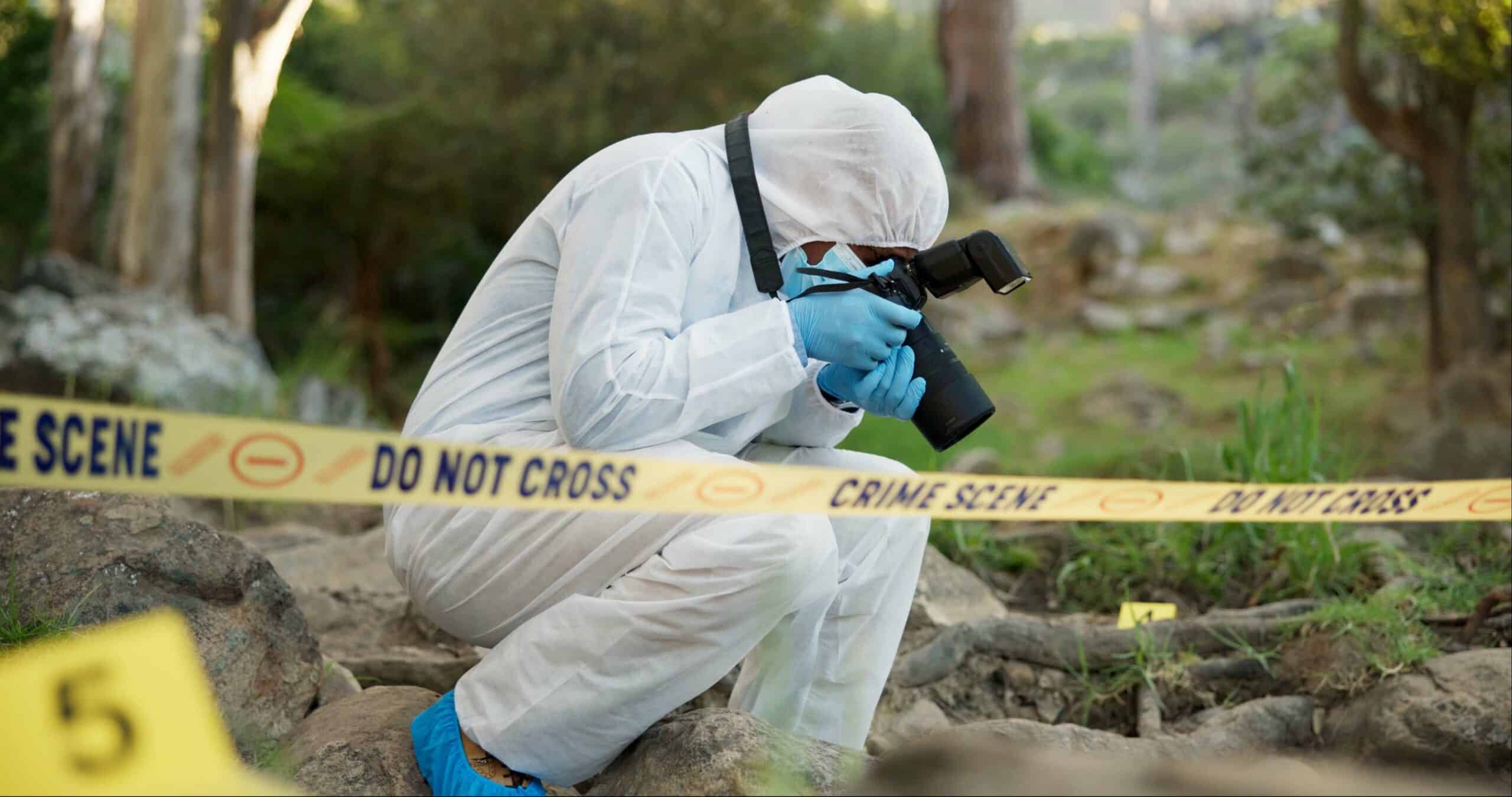
Investigators arrive at the scene to document, photograph, and collect physical evidence. Crime scene technicians recover items such as shell casings, weapons, blood evidence, and trace materials. The integrity of the crime scene—and how evidence is collected—can have significant implications for how that evidence is used at trial.
Search Warrants
Investigators may seek search warrants to enter and search homes, vehicles, or storage units connected to a suspect. Evidence seized during a search—including firearms, clothing, or electronic devices—may form the foundation of the prosecution’s case. If a warrant was obtained improperly or executed in violation of a defendant’s constitutional rights, that evidence may be subject to suppression.
Cell Phone Warrants and Digital Evidence
Law enforcement routinely obtains warrants for cell phone records, including call logs, text messages, location data, and app activity. This data can be used to place a suspect near a crime scene, establish communications with victims or co-defendants, or track movements before and after a death.
Surveillance Collection
Investigators gather footage from traffic cameras, business security systems, residential doorbell cameras, and other sources. Surveillance footage is often among the most powerful evidence in a homicide case—and one of the most important areas for defense review and challenge.
Witness Interviews
Law enforcement interviews neighbors, bystanders, associates, and anyone connected to the victim or suspect. Witness accounts can shift significantly between initial interviews and trial testimony. A skilled homicide defense attorney examines all prior statements for inconsistencies, bias, or coercion.
DNA Collection and Ballistics Testing
Biological samples collected at the scene are submitted for DNA analysis. Firearms and ammunition may be subjected to ballistics testing to determine whether a specific weapon fired the rounds recovered. Both forms of evidence are subject to laboratory error, contamination, and interpretive disagreement—all of which a qualified defense attorney and independent experts can address.
Medical Examiner Investigation and Autopsy
The county medical examiner conducts an autopsy to determine the cause and manner of death. The autopsy report, toxicology results, and medical examiner testimony can directly affect the charge level and the prosecution’s theory of the case. Defense attorneys may retain independent forensic pathologists to review findings and offer alternative conclusions.
Grand Jury Review
Before a murder charge proceeds to trial in New Jersey, prosecutors typically present their evidence to a grand jury. In Burlington County Superior Court, Camden County Superior Court, and Gloucester County Superior Court, grand juries are composed of 23 members who review the evidence to determine whether probable cause exists to indict. A grand jury proceeding is not a trial—but having legal representation during the investigation phase can affect what evidence is presented and how the prosecutor frames the case.
Arrest vs. Indictment
In some cases, law enforcement makes an arrest before completing the full investigation. In others, an indictment is secured first. Either way, the period between when a person becomes a target and when formal charges are filed is often the most critical window for building a defense.
If you believe you are under investigation for a homicide—even if you have not been arrested—contact a New Jersey homicide defense attorney immediately.
What Is the Difference Between Murder and Manslaughter in New Jersey?
The key difference between murder and manslaughter in New Jersey is intent. Murder requires proof that the defendant acted purposefully or knowingly; manslaughter involves recklessness, not an intent to kill.
| Charge | Degree | Key Element | Typical Penalty |
| Murder | First | Purposeful or knowing intent to kill | 30 years to life |
| Aggravated Manslaughter | First | Extreme recklessness; high probability of death | 10–30 years |
| Reckless Manslaughter | Second | Conscious disregard of substantial risk | 5–10 years |
| Passion/Provocation Manslaughter | Second | Heat of passion; reasonable provocation | 5–10 years |
| Felony Murder | First | Death during commission of a specified felony | 30 years to life |
Penalties for Homicide Charges in New Jersey
Homicide convictions in New Jersey carry some of the most severe sentences in the state’s criminal code. Penalties depend on the classification and degree of the charge, the defendant’s criminal history, and any aggravating or mitigating factors presented at sentencing.
Key penalty considerations include:
- Murder and felony murder: Mandatory minimum of 30 years; up to life in state prison; fines of up to $200,000
- Aggravated manslaughter: 10–30 years in prison
- Reckless manslaughter: 5–10 years in prison
- Enhanced penalties: Killing an on-duty police officer, firefighter, or child may result in a life sentence
- No Early Release Act (NERA): Those convicted of homicide must serve at least 85% of their sentence before becoming eligible for parole
- Financial consequences: Fines, victim restitution, and mandatory assessments to victim and first responder funds
Evidence Commonly Used in New Jersey Homicide Cases
Prosecutors build homicide cases using a wide range of physical, digital, and testimonial evidence. The table below outlines the most common evidence types, why prosecutors use each, and how the defense may challenge them.
| Evidence | Why Prosecutors Use It | How It May Be Challenged |
| DNA | Links suspect to crime scene or victim | Laboratory error, contamination, transfer, or chain of custody issues |
| Ballistics | Ties a firearm to recovered rounds | Expert disagreement on toolmark analysis; limitations of comparative testing |
| Fingerprints | Places suspect at the scene or on a weapon | Partial prints, environmental degradation, or examiner subjectivity |
| Cell phone records | Establishes location, communication, and timing | Tower data imprecision; warrant validity; data interpretation disputes |
| Surveillance footage | Identifies suspect or captures the incident | Image quality, angle limitations, misidentification |
| Autopsy findings | Establishes cause and manner of death | Independent review by forensic pathologist may yield different conclusions |
| Digital evidence | Emails, app data, photos, browser history | Chain of custody, extraction methodology, Fourth Amendment challenges |
| Social media | Prior statements, relationships, intent | Context, account ownership, authentication |
| Witness testimony | Eyewitness accounts, cooperative witnesses | Prior inconsistent statements, bias, incentives, perception issues |
| Jail calls | Admissions or incriminating statements | Context, recording accuracy, attorney-client privilege violations |
| Confessions | Direct admission of guilt | Voluntariness, Miranda compliance, coercion, false confession research |
Real-world example: In a self-defense shooting case, surveillance footage that appears damaging in isolation may support the defense when reviewed alongside witness statements and the victim’s prior conduct. An independent forensic review of autopsy findings may also challenge the prosecution’s narrative about how the shooting occurred.
Potential Defenses in a New Jersey Homicide Case
The appropriate defense strategy in a homicide case depends on the specific facts, evidence, and charge involved. An experienced New Jersey murder defense attorney will evaluate every available option.
Self-Defense or Defense of Others
New Jersey law permits the use of force, including deadly force, to protect yourself or another person from imminent serious bodily harm or death. Real-world example: A defendant who shoots an intruder during a home invasion, or a bystander who intervenes to protect a third party from a violent attack, may assert a self-defense claim supported by evidence of the threat faced.
Lack of Purposeful or Knowing Intent
Proving that the defendant lacked the mental state required for murder can result in a reduction to a lesser charge such as manslaughter. This is particularly relevant in bar fight cases, domestic disputes, or other situations where a death resulted from uncontrolled circumstances rather than deliberate action.
Challenging Causation
Prosecutors must prove that the defendant’s actions directly caused the victim’s death. In drug overdose investigations, for example, the defense may challenge whether the substances provided by the defendant were the actual cause of death, or whether intervening factors—such as the victim’s pre-existing medical conditions or use of other substances—broke the chain of causation.
Mistaken Identification
Eyewitness misidentification remains one of the leading causes of wrongful convictions in the United States. Real-world example: In a gang-related shooting involving multiple individuals, law enforcement may misidentify a bystander or peripheral associate as the shooter. Cross-examining identification procedures and presenting alibi evidence is a cornerstone of the defense in such cases.
Unreliable or Coerced Witness Testimony
Witnesses may be incentivized to testify by cooperation agreements, threats, or promises of leniency. A skilled homicide defense lawyer carefully scrutinizes all witness statements for inconsistencies, prior criminal history, or evidence of prosecutorial pressure.
False or Coerced Confessions
Research consistently shows that false confessions occur—particularly following prolonged interrogations. If a statement was obtained in violation of Miranda rights or through coercive tactics, a defense attorney can move to suppress it before trial.
Challenging Forensic Evidence
Forensic science is not infallible. DNA, ballistics, and fingerprint evidence are all subject to human error, contamination, and interpretive bias. Defense experts can conduct independent reviews that produce different—and legally significant—conclusions.
Constitutional Violations
If law enforcement violated the defendant’s constitutional rights—through an illegal search, an improper warrant, or prosecutorial misconduct—the resulting evidence may be suppressed. In extreme cases, such violations may support a motion for dismissal.
Challenging Accomplice or Conspiracy Allegations
In felony murder and robbery-related homicide cases, the prosecution may allege that multiple individuals share responsibility for a death. The defense can challenge whether the defendant’s level of participation satisfies the legal standard for accomplice liability.
Why Early Representation Matters in a Homicide Investigation
Hiring a homicide defense attorney before charges are filed is one of the most impactful decisions you can make. Investigations move quickly. Evidence is collected, witnesses are interviewed, and the prosecution’s theory of the case begins to form—often before a suspect is even aware they are a target.
Early representation allows your attorney to:
- Advise you on whether and how to respond to police interview requests
- Contest the scope and validity of search warrants before evidence is used against you
- Preserve digital evidence—including surveillance footage and communications—that supports your defense
- Retain independent investigators and forensic experts
- Appear before the grand jury process is complete, potentially influencing whether charges are filed at all
- Advise on public statements and media inquiries
You should never speak with law enforcement about a homicide investigation without first consulting with a criminal homicide lawyer. Even statements made with good intentions can be used against you.
The Role of Expert Witnesses in Homicide Defense
Expert witnesses are often central to the outcome of a homicide case. Prosecutors rely on them to present complex scientific evidence to juries. A strong defense requires independent experts who can challenge those findings or offer alternative conclusions.
Michele Finizio works with qualified experts in the following areas:
- Forensic pathologists: Review autopsy findings to challenge the cause or manner of death, dispute wound trajectory analysis, or identify alternative explanations for physical findings. In self-defense shootings, a forensic pathologist’s analysis of wound location and trajectory can be decisive.
- DNA experts: Examine laboratory procedures, chain of custody documentation, and statistical interpretation of DNA match probabilities. Even a small deviation from proper protocol can compromise the reliability of DNA evidence.
- Ballistics experts: Analyze firearm evidence to dispute whether a specific weapon fired the recovered rounds, or to challenge the accuracy of toolmark comparison methodology.
- Crime scene reconstruction experts: Re-examine the physical evidence to challenge the prosecution’s account of how events unfolded—particularly in cases involving multiple participants, disputed timelines, or self-defense claims.
- Digital forensic experts: Review how electronic evidence was extracted, stored, and interpreted. These experts can identify errors in cell phone data analysis, challenge the accuracy of location tracking, or establish that digital communications were taken out of context.
- Medical experts: Address injury-related issues beyond the scope of the autopsy, including the victim’s pre-existing conditions, the effect of medical treatment, or alternative causes of death.
- Psychologists and psychiatrists: Where legally relevant, mental health experts may support defenses related to diminished capacity, the defendant’s mental state at the time of the offense, or competency to stand trial.
How a New Jersey Homicide Case Moves Through the Court System
A New Jersey homicide case follows a structured legal process that can span one to three years from investigation to resolution. Understanding each stage helps defendants and their families prepare.
- Investigation: Law enforcement—often working with the Burlington County Prosecutor’s Office, Camden County Prosecutor’s Office, or Gloucester County Prosecutor’s Office—collects evidence, executes warrants, and interviews witnesses.
- Arrest or criminal complaint: Formal charges are initiated, either through a warrant-based arrest or a complaint filed by law enforcement.
- First appearance: The defendant appears before a judge to enter an initial plea and is informed of the charges.
- Pretrial detention hearing: A judge determines whether the defendant will be released pending trial or held in custody.
- Grand jury: A panel of 23 jurors reviews the evidence to determine whether probable cause exists to indict. Cases handled at Burlington County Superior Court, Camden County Superior Court, and Gloucester County Superior Court follow this process.
- Indictment: If the grand jury finds sufficient evidence, a formal indictment is returned and the case proceeds to Superior Court.
- Discovery: Both sides exchange evidence, including police reports, forensic results, witness statements, and expert reports.
- Pretrial motions: Your attorney may move to suppress evidence, dismiss charges, or address legal issues before trial.
- Plea negotiations: The defense and prosecution may negotiate a resolution short of trial, including reduced charges or a recommended sentence.
- Trial: The case is presented before a judge and jury. The prosecution must prove guilt beyond a reasonable doubt on every element of the charge.
- Sentencing: If the defendant is convicted, the court imposes penalties based on the charge, criminal history, and statutory guidelines.
Why Choose Michele Finizio for Your Homicide Defense?
Choosing the right homicide defense attorney can be the most consequential decision you make. The Law Office of Michele Finizio offers the following to every client:
- Experience in serious criminal matters: Michele Finizio has spent years defending clients against the most serious charges in New Jersey’s criminal courts, including Burlington County Superior Court, Camden County Superior Court, and Gloucester County Superior Court.
- Thorough, independent investigations: Rather than relying solely on the prosecution’s evidence, Michele conducts her own independent investigation—reviewing police reports, interviewing witnesses, and identifying inconsistencies in the state’s case.
- Access to qualified independent experts: Michele retains forensic pathologists, DNA analysts, ballistics experts, digital forensic specialists, and other professionals to challenge the prosecution’s scientific evidence.
- Strategic pretrial negotiations: Not every case goes to trial. Michele evaluates all options—including plea negotiations and charge reductions—and provides candid, informed advice about the potential outcomes of each path.
- Trial-ready representation: When trial is the right course, Michele prepares thoroughly and advocates aggressively for her clients before juries in South Jersey courts.
- Personalized defense strategies: No two homicide cases are alike. Michele develops individualized strategies based on the specific facts, evidence, and goals of each client.
- Free consultation: Michele offers a 100% free, no-obligation consultation to discuss your situation and your options.
Related Charges
A homicide investigation often involves related criminal allegations. Michele Finizio also defends clients facing:
- Attempted Murder — Charges alleging an intent to kill that did not result in death
- Aggravated Assault — Serious bodily harm charges that may accompany or precede homicide allegations
- Weapons Offenses — Unlawful possession or use of a firearm in connection with a death
- Gun Crimes — Federal and state firearms charges that frequently arise in homicide investigations
- Drug Crimes — Charges connected to overdose deaths or drug-related homicide allegations
- Domestic Violence — Homicide charges arising from domestic disputes or intimate partner violence
- Criminal Defense — Comprehensive representation for all serious criminal matters in New Jersey
Speak With a New Jersey Homicide Defense Attorney
If you are under investigation or facing a homicide charge, the decisions made during the earliest stages of the case may determine its outcome. Contact the Law Office of Michele Finizio to discuss your situation and your defense options.
The consultation is 100% free and confidential—whether you are facing a first-degree murder charge, a manslaughter allegation, or believe you are the target of a homicide investigation.